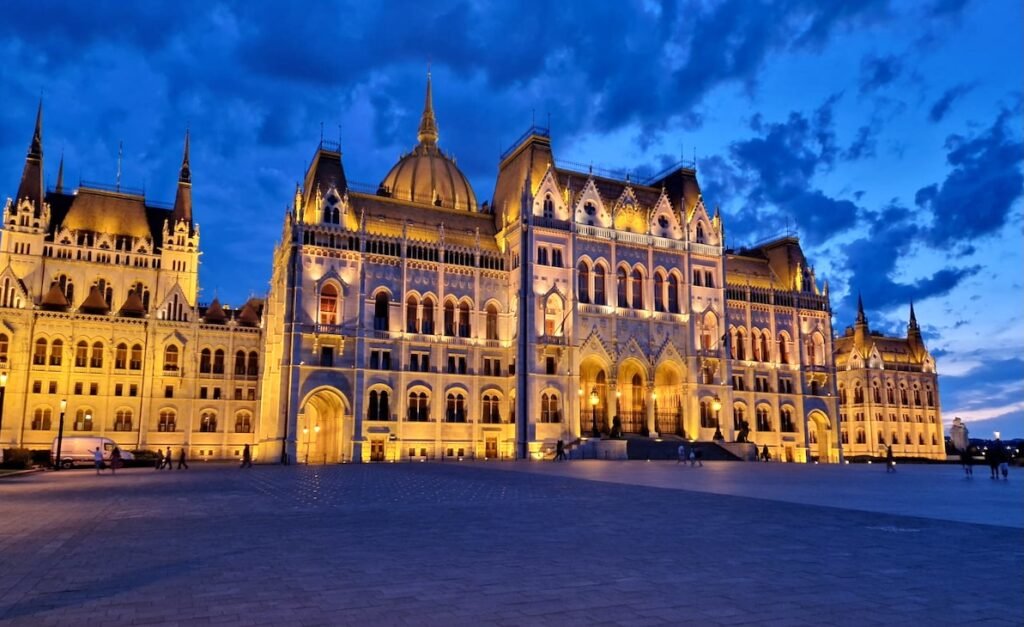
Budapest has plenty of show‑stopping façades, but nothing quite prepares you for the moment the Hungarian Parliament Building Budapest comes into view on the Danube riverfront—an illuminated Gothic silhouette reflected in the water, framed by bridges and the Buda hills.
It’s not just a postcard icon: this is a working seat of Hungary’s National Assembly and the home of the Holy Crown, which gives the building a rare mix of beauty, gravitas, and living political relevance.
If you’re visiting Budapest for three days—or you’re an expat planning the perfect “wow” day for guests—this guide covers the details that matter: Hungarian Parliament opening hours, Budapest Parliament tickets, how the Budapest Parliament tour works, and the rules that can make or break your visit.
Fast Facts: Hungarian Parliament at a Glance
| Fact | Details |
|---|---|
| Official name | Országház (“House of Parliament”) |
| Architect | Imre Steindl |
| Construction | 1885–1902 (built over 17 years) |
| Dome height | 96 metres |
| Style | Gothic ornamentation with a Baroque plan and Renaissance interior elements (a deliberate mix) |
| Location | Kossuth Lajos tér (Kossuth Square), 1055 Budapest, Kossuth Lajos tér 1–3 |
| Tour duration | 45 minutes |
| Ticket price range (2026) | HUF 3,500–14,000 (typical student–adult range; EEA vs non‑EEA pricing applies) |
| Where tours start | Underground Visitor Centre (north part of Kossuth Square) |
History & Architecture: From Millennium Ambition to National Symbol
The Parliament you see today was born during Budapest’s late‑19th‑century growth spurt—an era that also reshaped avenues, stations, bridges, and urban pride.
The Hungarian state commissioned the project with clear intent: use Hungarian materials, involve Hungarian craftsmen and manufacturers, and even weave Carpathian Basin flora into decorative motifs.
The “Millennium” context (why 1896 matters)
Budapest’s famous 1896 Millennium celebrations marked 1,000 years of Hungarian statehood traditions linked to the Hungarian Conquest.
Parliament sources note that planners accelerated and reshuffled construction so the National Assembly could hold a commemorative sitting in the new building around the Millennium period.
The number 96: more than a measurement
Officially, the dome height is 96 metres—and the number appears again in the 96 steps of the Grand Stairway on the visitor route.
Parliament’s own timeline ties the building’s construction programme closely to the 1896 Millennium push, which helps explain why “96” is treated as a recurring motif rather than a random figure.
A colossal build—by European “mega‑project” standards
The House of Parliament is huge by any measure:
- Around 18,000 m² of floor space and 473,000 m³ in volume
- Built with about 40 million bricks and 30,000 m³ of carved stone
- Decorated with 40 kg of 22–23 carat gold
- A façade lined with 90 stone statues, plus many more inside
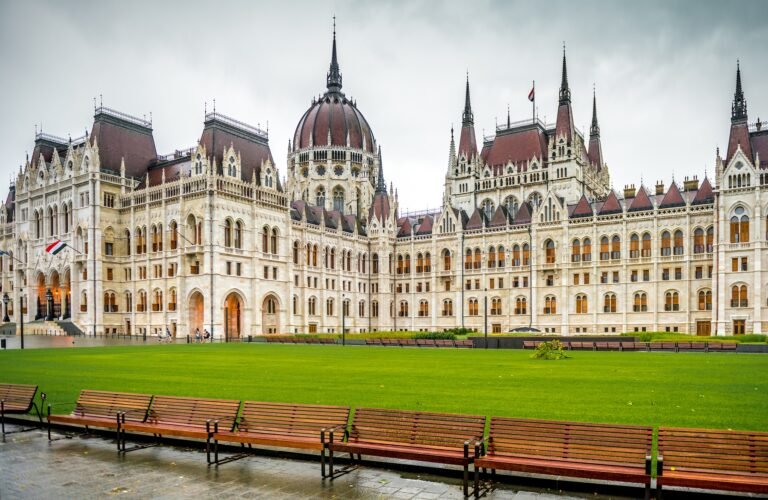
And although the exterior reads as Gothic—spires, buttresses, sculpted drama—the building is intentionally eclectic: Baroque in plan, Gothic in ornamentation, Renaissance in parts of the interior program.
Political significance today
This isn’t a museum building that happens to look like a palace. It’s the workplace of Hungary’s legislative body, and it also houses the Holy Crown—still central to Hungarian state symbolism.
Planning Your Visit
Hungarian Parliament opening hours (2026)
The Visitor Centre and tours follow a seasonal schedule:
- 1 Jan – 31 Mar: daily 08:00–16:00
- 1 Apr – 31 Oct: daily 08:00–18:00
- 1 Nov – 31 Dec: daily 08:00–16:00
Real‑world note: Visits can be cancelled even shortly before entry due to parliamentary or state events, so check official updates close to your date.
Budapest Parliament ticket prices (EEA vs non‑EEA)
Admission fees from 1 January 2026 are clearly separated by eligibility:
- EEA adult: HUF 7,000
- EEA student (6–24): HUF 3,500
- Non‑EEA adult: HUF 14,000
- Non‑EEA student (6–24): HUF 7,000
- Under 6: free
EEA eligibility is defined on the official page (EEA national or residence card accepted), and you must show proof for discounts.
How to book tickets online (official process + link)
Advance tickets are not sold at the Visitor Centre ticket office.
To book ahead, you must purchase online via the official ticketing partner: www.jegymester.hu/parlament.
Practical booking steps (what to do):
- Choose your date/time on the official ticket site (Jegymester).
- Buy the correct category (EEA vs non‑EEA; student/family where relevant).
- Bring the documents needed to prove discount eligibility or status when you arrive.
Tip: The Parliament explicitly warns that it assumes no liability for overpriced/counterfeit tickets bought elsewhere—another reason to stick to the official route.
Are same‑day tickets available?
Yes—but only in limited numbers at the Visitor Centre ticket office, and it can take time to buy on the spot.
If you have fixed travel dates (especially weekends), booking online is the safer play.
Tour languages
The standard 45‑minute guided tour is available with an audioguide or a professional guide in: Hungarian, English, French, German, Italian, Spanish.
Additional audioguide‑only languages are offered (including, for example, Polish, Russian, Korean, Japanese, Chinese, Arabic and more).
How long is the Parliament tour?
The official tour length is approximately 45 minutes.
Plan extra time for security screening and getting to the underground Visitor Centre—especially if you’re arriving right at your slot.
Find out exactly what ATS scanners see.
What to Expect Inside (A First‑Timer’s Walkthrough)
1) Visitor Centre: your starting point
Tours depart from the underground Visitor Centre in the northern part of Kossuth Square.
It’s also where you’ll find public lavatories—useful to know, because you don’t want to be thinking about logistics once you’re inside the grand spaces.
2) Security screening (airport‑style, but faster if you’re prepared)
A security check is required before entry.
Avoid bringing large bags or anything that could be interpreted as dangerous (knives, gas spray, etc.), as these are explicitly restricted.
Insider tip: Travel light and keep your pockets simple (keys, phone, wallet). It’s the easiest way to keep your group moving.
3) The Grand Stairway (yes, that red‑carpet moment)
The tour famously climbs through richly decorated stair spaces—one highlight is the Grand Stairway with its 96 red‑carpeted steps and dramatic artistic programme.
You’ll also see show‑piece materials: for example, the visitor route notes eight four‑tonne granite columns, a rare set type.
4) Dome Hall + the Holy Crown of Hungary
The Dome Hall is positioned as the symbolic centre—this is where the Hungarian Holy Crown and Coronation Insignia have been kept since 1 January 2000, protected continuously by the Crown Guard.
Photography rule (important): it is strictly forbidden to take photographs in the great Dome Hall (for the protection of the Holy Crown).
5) Chamber spaces and historic interior.
The Parliament was designed with two matching chambers reflecting the building’s bicameral past, flanking the Dome Hall—an architectural way of expressing legislative “balance” and unity.
On the visitor route, you typically continue into richly panelled halls and a former chamber space used today for events.
6) Photography rules (what’s allowed)
- No photos in the great Dome Hall (Crown area).
- Photography/video is allowed in other parts of the building.
- Follow guide instructions—tour guides’ directions are enforceable, and visitors can be escorted out for breaking rules.
Accessibility & Practical Tips for Expats
Step‑free access & mobility needs
The House of Parliament is described as accessible to people with disabilities.
The Visitor Centre is a handicapped‑accessible complex and is the starting point for visitors with visual or physical impairments.
If you’re arriving with a wheelchair, the Parliament requests you inform staff in advance by email (tourist.office@parlament.hu) to ensure smooth access.
Getting there (public transport that actually makes sense)
The closest metro is Kossuth Lajos tér on the M2 line, with connections that include Tram 2 (and related lines).
This is one of those rare Budapest attractions where the “best transport” is also the most scenic: Tram 2 runs along the river, giving you cinematic Danube views on the way in.
Best times to visit (how locals avoid the crush)
From living here, I’ve learned one simple rule: take the earliest tour slot you can manage. The square feels calmer, security lines are shorter, and you get cleaner photos outside before the crowds multiply.
For summer hosting strategy (expats):
- If friends/family visit in peak season, treat Parliament tickets like a “must‑book” rather than a “we’ll see.” Same‑day options exist, but are limited.
- Keep the official cancellation reality in mind: protocol events can disrupt visits, so build in a plan B (Danube cruise or Buda viewpoints) even if you have tickets.
What to bring (and what not to)
Bring:
- ID/passport + any document proving eligibility for your ticket category/discount.
Avoid:
- Large bags and restricted items (knives, gas spray, weapons, etc.).
Best Viewpoints & What to Do Nearby (Itinerary‑Friendly)
If you want the classic “Budapest skyline” moment, don’t stop at the tour exit. Pair Parliament with a short, high‑impact route.
Best viewpoints for photos
- Across the river on the Buda side: the Parliament’s symmetry reads best from a distance—especially near Batthyány tér.
- Danube river cruises: the building’s riverside façade was literally designed to face the Danube, so the waterline view feels intentional, not accidental.
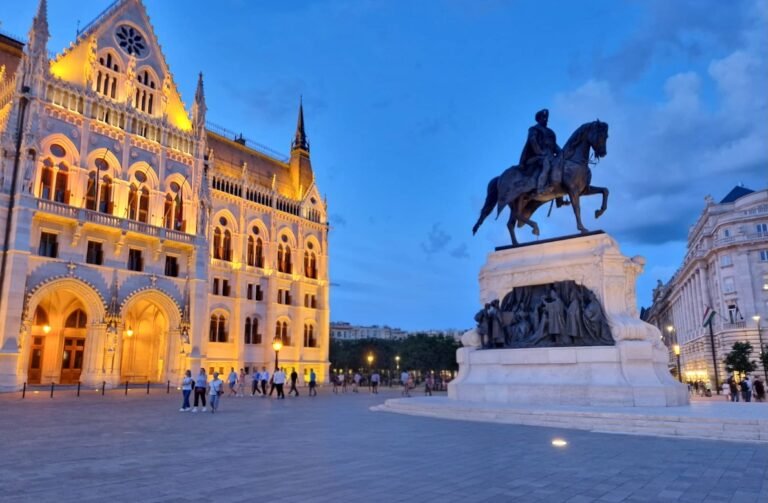
- Kossuth Square at blue hour: arrive just before dusk, watch the lights come on, then cross for night shots.
Nearby “must‑sees” within walking range
- Shoes on the Danube: a moving memorial on the riverbank—easy to combine before or after your tour.
- Buda Castle + Fisherman’s Bastion: the unbeatable panorama pairing—Parliament from above is a Budapest rite of passage.
- Margaret Island: when you want greenery and a reset after ornate interiors.
Quick half‑day plan (works for tourists + expats with guests):
- Morning Parliament tour
- Walk the riverbank toward the memorials and bridges
- Cross to Buda for the viewpoint finale
Fun Facts & Local Insights (The Stuff You’ll Repeat Later)
- “96” pops up twice on the visitor experience: the 96‑metre dome and the 96 steps of the Grand Stairway.
- Builders accelerated works so the Assembly could use the building during the 1896 Millennium periods.
- The building’s scale is mind‑bending: the official site compares its volume to 50 five‑storey apartment buildings.
- The Holy Crown and insignia have been kept in the Dome Hall since 1 January 2000, under continuous guard.
- The Parliament itself highlights “old‑fashioned exterior, modern technology”: steel roof structure, advanced heating/cooling for its era, and integrated systems (with later renovations).
Local photo hack: If you can’t photograph the Crown area (you can’t), shift your “interior photo goal” to the stained glass, stair spaces, and long corridor perspectives—those are where Budapest’s Parliament feels most cinematic.
FAQ (Budapest Parliament 2026)
1) Is the Hungarian Parliament worth visiting?
Yes—because it’s both an architectural landmark and a functioning seat of Hungary’s National Assembly, plus the home of the Holy Crown.
The official visitor route takes you through signature spaces like the Grand Stairway and Dome Hall, making it one of the most memorable Budapest attraction.
2) How much do Budapest Parliament tickets cost in 2026?
As of 1 January 2026, official prices are HUF 7,000 for EEA adults and HUF 14,000 for non‑EEA adults, with discounted student pricing (6–24) and free entry under 6.
Eligibility checks can apply, so bring documents with you.
3) How long is the Budapest Parliament tour?
The standard guided visit is 45 minutes.
Give yourself extra buffer for security screening and finding the underground Visitor Centre—especially if you’re on a tight city schedule.
4) What are the Hungarian Parliament opening hours?
The official seasonal schedule is 08:00–18:00 from 1 April to 31 October, and 08:00–16:00 from 1 November to 31 March (daily).
Visits can be cancelled at short notice for state or parliamentary events, so check updates close to your date.
5) How do I book tickets online (officially)?
Advance tickets are only available online via the official ticketing partner www.jegymester.hu/parlament.
The Visitor Centre ticket office does not sell advance tickets.
Avoid third‑party resellers; the Parliament warns it assumes no liability for problems from other sites.
6) Are same‑day tickets available at the Parliament?
Sometimes—same‑day tickets can be purchased in limited numbers at the Visitor Centre ticket office.
However, availability is not guaranteed and buying on the spot may take time, so booking online is safer when you can.
7) Is photography allowed inside the Parliament?
Photography and video are allowed in many parts of the building—but photographs are strictly forbidden in the great Dome Hall to protect the Holy Crown.
Follow guide instructions closely; visitors can be escorted out for breaking conduct rules.
8) What is the dress code for visiting the Hungarian Parliament?
The official guidance is simple: dress appropriately and behave respectfully because of the building’s dignity.
Certain behaviours are explicitly forbidden (e.g., eating/drinking, protest items, loud demonstrations), and rules are enforced by staff.
9) How do I get to the Hungarian Parliament by metro?
Take Metro line M2 to Kossuth Lajos tér station, which sits right by the Parliament area.
From there, it’s a short walk across Kossuth Square to the underground Visitor Centre where tours begin.
10) Is the Hungarian Parliament accessible for wheelchair users?
The Parliament states it is accessible to people with disabilities and asks wheelchair users to contact staff in advance via email to ensure smooth access.
Tours begin at the handicapped‑accessible Visitor Centre complex in Kossuth Square.
Conclusion (A Local’s Nudge)
If you do just one “big icon” in Budapest, make it the Parliament—because it’s the rare attraction that feels even better in real life than in photos, especially when you approach along the Danube and then step into the building’s ceremonial heart.
Book via the official channel, arrive a little early for security, and plan a riverside walk afterward—you’ll leave with a deeper sense of why this city’s skyline is so unforgettable.